
Ketchup
From fish brine to red sauce

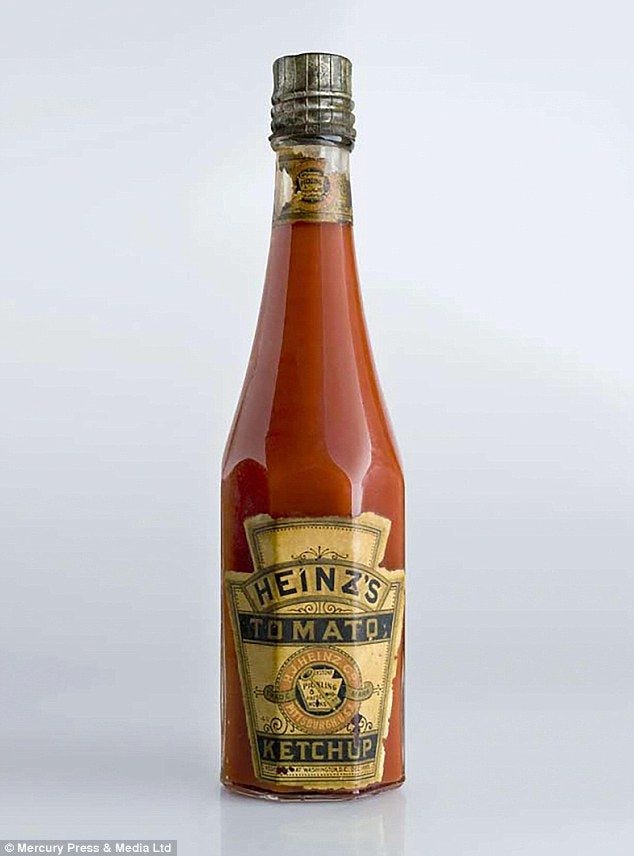
The word “ketchup” entered English in 1682, in a pamphlet on coffee, tea, chocolate, and tobacco that listed it among foreign luxuries, alongside caviar and cantharides, better known as Spanish fly. A cookbook the next year called for it in a recipe. This was a dark, salty, savory liquid, a cousin of soy and the fish sauces of Asia. Its ancestor, the Oxford English Dictionary says, was a Southeast Asian sauce “probably made from fermented soybeans or fish,” which English traders and travelers had acquired a taste for in the East and brought home. Tomatoes and sugar came only in the nineteenth century; the word had reached England long before.
In the ports of the South China Sea, ketchup was an article of trade. In 1711 Charles Lockyer, a merchant in the East India trade, noted that soy came in tubs from Japan and the best ketchup from Tonquin – northern Vietnam, a coast long known for its fish sauce. The word was Hokkien, spoken along the Fujian coast and carried abroad by Fujianese sailors. The OED’s chief editor, James Murray, traced it to a missionary’s dictionary of the Amoy dialect, the speech of the port now called Xiamen. There kôe was defined as salted or pickled fish or shellfish, and kôe-chiap as the brine it lay in. The second syllable, chiap, written 汁, still means juice or sauce across southern China. The first, kôe, is harder to place: the OED gave only its romanized form, and the character behind it has never been settled. Some read it as 鮭 (Mandarin guī), now the word for salmon but once a name for cured fish; the Dictionary of Frequently-Used Taiwanese, from Taiwan’s Ministry of Education, writes it 膎 (Mandarin xié), fish, shrimp, or meat preserved by salting. Whichever character is right, the sense is the same: ketchup began as the brine of salt-cured fish.
Fish sauce was ancient in China. A sixth-century farming manual, the Qimin Yaoshu (齊民要術), gives a recipe for it – the guts of croaker, mullet, and shark, salted, sealed in a jar, and left in the sun until ripe – and a story to go with it. Emperor Wu of Han (156–87 BCE), chasing the Yi people to the coast, caught a delicious smell, traced it to a pit where a fisherman had buried fish guts to ferment, and liked what he found. The sauce took its name from the chase: 鱁鮧 (zhúyí), a pun on 逐夷 (zhúyí, “to chase the Yi”). But the Chinese came to prefer fermented soybeans, cheaper and easier to carry, and by the seventeenth century soy sauce and bean pastes were the standard seasonings across most of the country. Fish sauce survived mainly in the southeast, along the coasts of Fujian and Guangdong. Farther south, along the Mekong, fermented fish remained central, as it still is in Vietnamese nuoc mam and Thai nam pla. Food historians argue that fish sauce returned to the Chinese coast from the south in the seventeenth and eighteenth centuries, carried north by sea traders working the Vietnam and Cambodia routes. Those traders were Hokkien speakers, and the brine they sold as kôe-chiap was the ketchup the British would soon encounter. Whether they had carried it up from the Mekong or had long salted their own is still debated.
English cooks imitated the imported sauce with whatever local ingredients gave a similar savory taste, and the name came to cover a whole family of sauces that shared little but that name and a method: dark, salty, spiced, and bottled to last. Mushroom was the usual base – a 1733 housekeeping manual lists “Kitchup, or Mushroom Juice,” and a mycologist still counted ketchup among the uses of fungi in 1875 – but oyster, walnut, and anchovy ketchups all had their place. As late as 1913, the American Webster’s still defined catsup as a sauce of mushrooms, tomatoes, walnuts, and the like, tomatoes only one ingredient among several.
The tomato reached the European table late: a New World fruit, grown in Europe since the sixteenth century but long avoided as poisonous. The first known tomato ketchup was American, a recipe published in 1812 by James Mease, a Philadelphia physician. He called the tomatoes “love apples,” as people then did, and bottled them with salt, spices, and brandy, but with neither vinegar nor sugar. Some early tomato ketchups even kept anchovies, a last trace of the fish-sauce original. Over the following decades American cooks reworked the sauce, dropping the fish, adding sugar, and sharpening it with vinegar; tomato ketchup became sweet, red, and tangy.
After the Civil War, American canners multiplied, and tomato ketchup became a cheap, mass-produced commodity; Americans grew used to the tomato cooked and bottled long before they would eat it fresh – though in Mexico, where it had been domesticated, people had eaten it fresh for centuries. Much of that factory ketchup was barely fit to eat: tomatoes ripen in a short season and the pulp soon spoiled, so some makers worked from the trimmings swept off the cannery floor, holding off rot with coal-tar dye and sodium benzoate. When Congress passed the Pure Food and Drug Act in 1906, ketchup drew particular scrutiny. The government’s chief chemist, Harvey Wiley, had tested benzoate and other preservatives by feeding measured doses to a dozen young volunteers, whom the newspapers called his “Poison Squad.” He pressed to ban it; manufacturers answered that ketchup could not be preserved without it. Heinz had already shown otherwise: by 1906 it was selling a benzoate-free ketchup, made from ripe tomatoes cooked down with heavy doses of vinegar and sugar. Those heavy doses, the price of preserving the sauce without benzoate, are why ketchup is sweet and sharp today.
The sweet red sauce was American. In Britain the older ketchups held their ground – mushroom ketchup is bottled and sold there still – and the tomato kind arrived only later, as an import.
The word’s spelling took even longer to settle than its recipe. The same word had come into English in more than one form – ketchup, catchup, and catsup, spelled and pronounced several ways – and for two centuries none won out. What finally fixed it was a brand. Heinz launched its sauce in 1876 as “Heinz Tomato Catsup,” soon changing the spelling to “Ketchup” to set itself apart from its rivals. As the H. J. Heinz Company came to dominate the market, so did its spelling. The others followed: Del Monte still printed “catsup” on its labels as late as 1988, by which time the question was long settled. “Catsup” still turns up here and there, mainly in North America.
Meanwhile, tomato ketchup had taken root in India. By the early 1900s recipes for spiced tomato sauce were appearing in cookbooks of the Raj. Later brands followed – Kissan, and from the 1980s a chili-spiked Maggi – and Indians took to the sauce so thoroughly that Heinz, arriving in 2000, struggled to compete. Indians call it simply “tomato sauce” and reach for it across the country, with everything from fried snacks to plain biscuits. In the south it now appears alongside the dosa, next to sambar and coconut chutney.
Ketchup is eaten in China too. In Hong Kong’s diners it is cooked into the sweet tomato sauce poured over baked pork chops and rice, and squeezed onto fried food; the Cantonese call it 茄汁 (ke2 zap1) – 茄, short for 番茄 (faan1 ke2), the tomato; 汁 (zap1), the sauce. The name is so close to the English that many in Hong Kong take “ketchup” for a word they gave the world. But the original ketchup was dark, salty, and fishy, and the Cantonese condiment closest to it is brown: 啲汁 (gip1 zap1), the Worcestershire sauce often served with steamed beef balls at dim sum. Most Cantonese dictionaries, as the Sinologist Victor Mair notes, derive that name from English “catsup.” If they are right, the word survives in the brown sauce, the one nearest the fermented original, while the red sauce keeps only its sound.
A note on sources
The word’s history and its earliest English quotations – the 1682 pamphlet, the 1683 cookbook, and Charles Lockyer’s account of 1711 – are drawn from the Oxford English Dictionary (s.v. “ketchup”), which also gives the Hokkien etymology that James Murray first worked out. Dan Jurafsky gathered much of this story in “Ketchup,” on his blog The Language of Food, and in his book of the same name; Victor Mair’s Language Log post “‘Tomato Sauce’ in Cantonese” supplied the Cantonese material, 茄汁 and 啲汁 among it. For the Chinese background I have relied on H. T. Huang’s volume on fermentation in Joseph Needham’s Science and Civilisation in China, which translates the Qimin Yaoshu passage, and on the food anthropologist Naomichi Ishige’s work on the fish-sauce and soy regions of East Asia. Andrew F. Smith’s Pure Ketchup is the fullest account of the American sauce; the Library of Congress’s “Playing Ketchup” covers Harvey Wiley and the Poison Squad; and Nikhita Venugopal’s “Relish,” in FiftyTwo, follows ketchup’s career in India.
Freely available online: Jurafsky, “Ketchup”; Mair, “‘Tomato Sauce’ in Cantonese”; Library of Congress, “Playing Ketchup”; Venugopal, “Relish”; Smith, Pure Ketchup; and the OED entry (behind a subscriber paywall).